
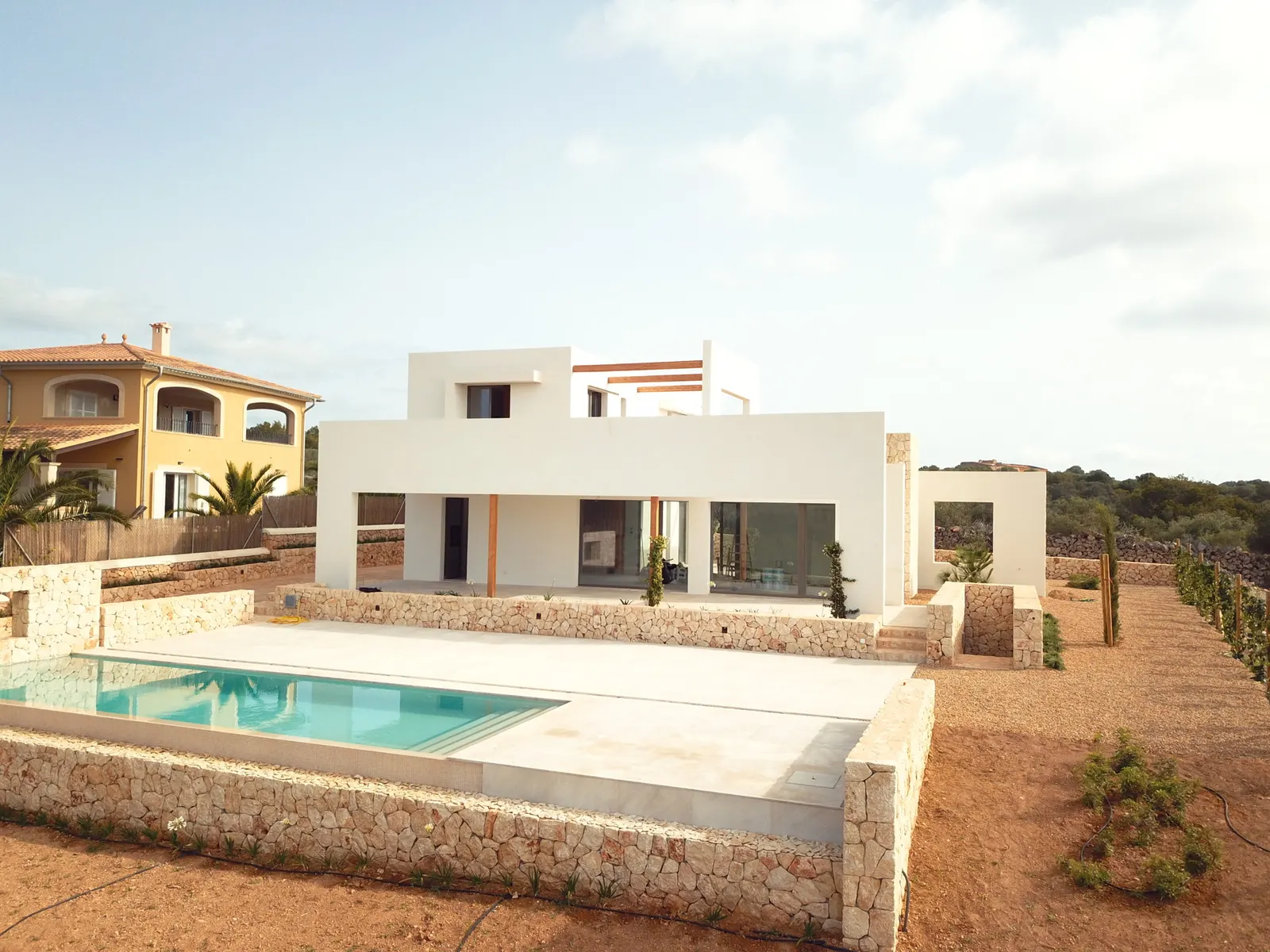
Comfort and sustainability in the purest Mediterranean style
A house that requires hardly any energy for heating or cooling
Casal Mallorquí is your partner for a sustainable and ecological house on Mallorca.
To achieve a comfortable temperature, passive houses consume 90% less energy annually than a conventional house. This eliminates the need for conventional heating and air conditioning systems, which consume a lot of electricity.
less energy per year than a conventional house to reach a comfortable temperature
primary energy requirement for heating and cooling per year
a year for a 200 sqm house, where a standard house needs about 3000 €
the energy of one light bulb keeps the house at 21 °C
Great comfort and sustainability
There are people who choose it because it is the most responsible and environmentally conscious building concept for our planet. But there is another crucial reason to choose to build a passive house on Mallorca: the comfort that you and your loved ones will experience when you live in the house.
Because it is a proven fact. Passive houses are much more comfortable and user-friendly than houses built according to traditional construction methods.
After all, that’s what we all want from a home that we can live in comfortably with our family, right? A comfortable home where we can enjoy every room.
A house where we can walk barefoot without feeling temperature changes when we stand near a window.
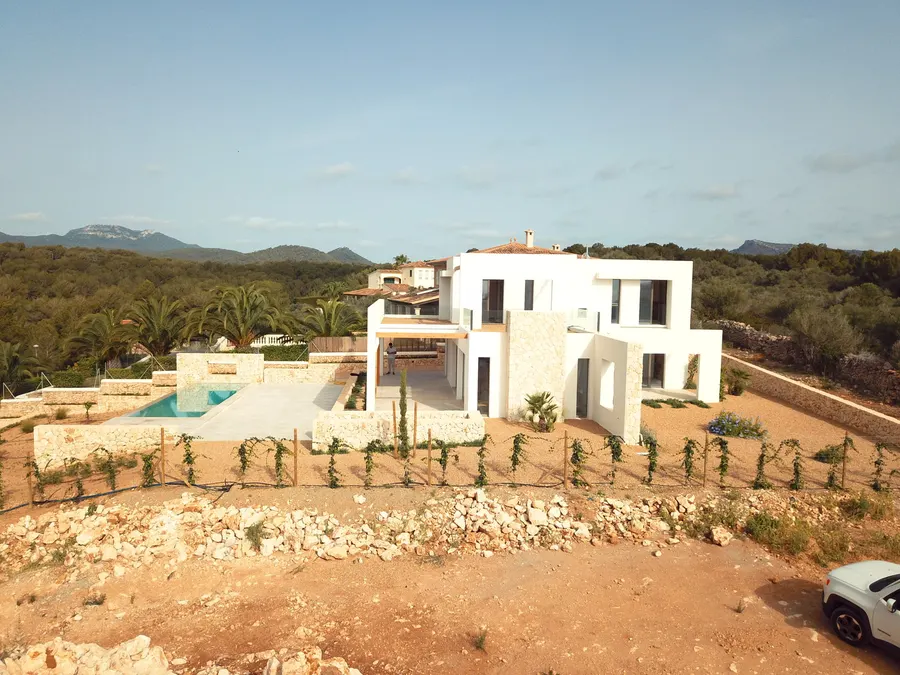 Passive house, Cala Murada
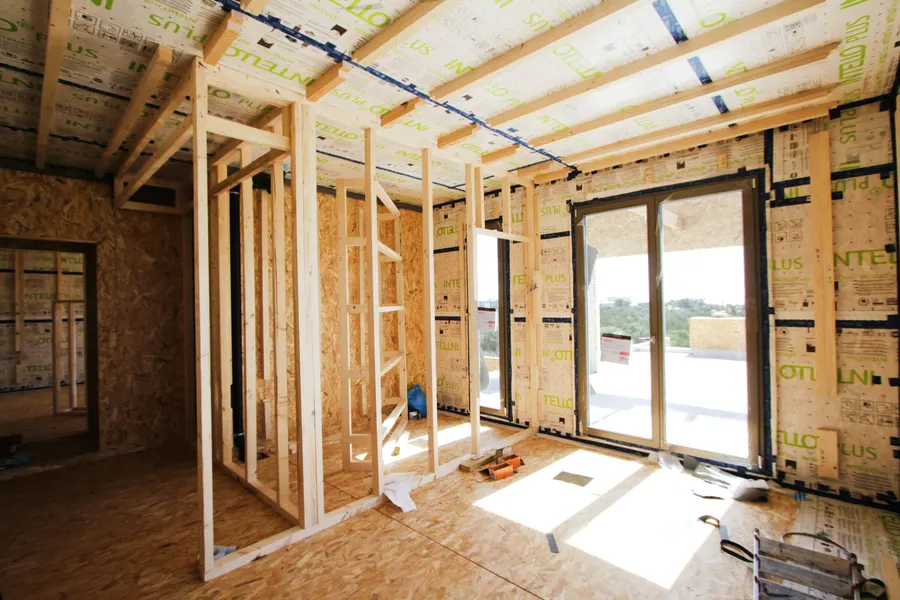 Wooden structure
The most effective application of physical principles to building
The thousands of Passive Houses already built and in use around the world and the exponential growth of this building standard today are irrefutable proof of its effectiveness.
However, there is much more valuable evidence: the satisfaction of the inhabitants of this type of house and the reactions of those who live in a Passive House.
There is no doubt that the comfort achieved does not leave anyone indifferent.
Your life will change positively when you live in a passive house

Reduction of colds
By avoiding drafts and sudden temperature changes between different rooms of the house, the temperature is controlled much better than in a standard house. This reduces the risk of colds and flu for the whole family.

Calm improvement
The thick walls contribute to better sound insulation. Passive houses are quiet houses that prevent outside noises that cause stress and insomnia. Therefore, you will have a better rest and feel more optimistic and productive.

Good air treatment
The ventilation system with heat recovery replaces conventional heating and cooling systems and provides constant air exchange. The result is pure, clean air circulating throughout the house, maximizing comfort for anyone with respiratory problems or allergies.

Time saving during construction
The construction time of your passive house can be significantly reduced if, instead of the traditional construction method, you choose a structure and a thermal wall layer made of wood, which is delivered to the construction site already prefabricated.

Permanent money saving
A passive house saves you money in the long run, as it reduces heating and cooling needs by 90%. In a standard house of 200 sqm, the normal consumption is about 3000 € a year. In a passive house this drops to 300 € a year, a saving of 2700 € a year.

Moisture avoidance
Conventional houses often suffer from moisture due to insufficient ventilation or thermal bridges. The airtightness of the construction of passive houses puts an end to condensation problems and keeps the dreaded moisture out.
The inhabitants of a passive house tell you something interesting about the house
Imagine living in a house with a comfortable temperature all year round and almost no energy consumption.
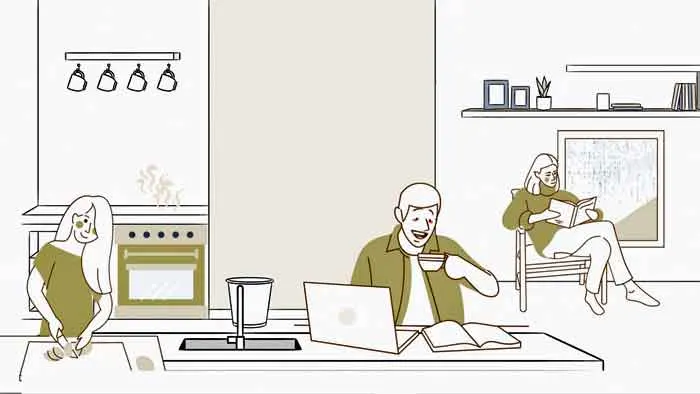
“It’s like magic!”
Passive houses require very little energy to heat up, as they only emit heat when it is needed. In many cases the residual heat emitted by an oven while cooking, a toaster, a computer, a light bulb or the sunlight itself is enough to warm them up. This fact amazes those entering a Passive House for the first time.
“Our electricity bill is very low”
Passive houses have a primary energy requirement for heating and cooling of only 15 kWh/m² per year. These figures may not mean anything to you at first glance, but they are incredible when you consider that a conventional house consumes about 90% more. This saves you a lot of money on your electricity bill.
“Is it raining?”
Passive houses are extremely quiet. Their superior soundproofing blocks outside noise so you won’t even hear the raindrops falling. The insulation is so good that a passive house can even be built next to an airport without the occupants hardly hearing the planes. The absence of the usual sounds of traffic, construction, thunderstorms and neighbours will improve your family’s sleep, mood and ability to concentrate.
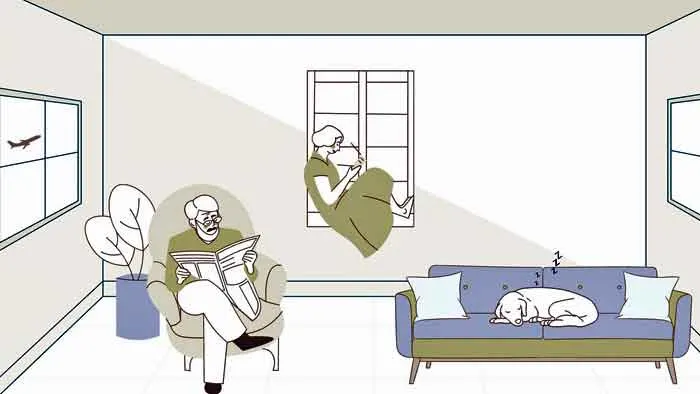
“They like to sit by the window and read”
In winter it is usual in a house that, even in the same room, there are different temperatures: a colder one near the windows and the walls of the facade and a warmer one inside the room. This difference leads to thermal discomfort. Passive houses maintain a minimal difference between the indoor temperature and the temperature of the outward-facing walls and windows, so you can use the spaces near external walls and windows as a reading or relaxation area.
“How long has it been since we dusted off?”
One of the biggest advantages of passive houses, apart from their low energy consumption, is the indoor air quality. There are no smells, no pollen, no CO2 concentrations and no accumulation of dust on sofas, furniture and curtains. The clean microclimate improves the quality of life for residents, and especially for those suffering from asthma, allergies or respiratory diseases.
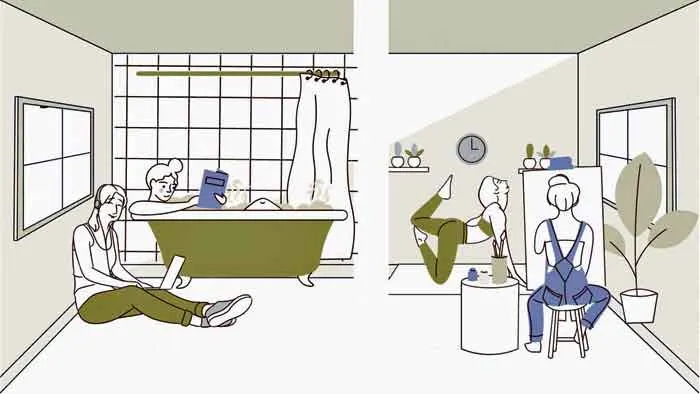
“The windows do not fog up”
The passive house exchanges the entire volume of air in the house at least every 3 hours. This avoids the concentration of CO2, but also of water vapour, which can lead to humidity in the house. The house maintains optimal humidity for its occupants: above 60% relative humidity, dust mites, mold and bacteria multiply, and below 40% the mucous membranes of the residents become dry.
“How wonderful it feels to get out of the bath!”
In a passive house, the same temperature is reached in all rooms. This prevents annoying temperature differences between rooms or when getting out of the shower.
“Let’s practice yoga in front of the window!”
The stable temperature and absence of air currents and filtrations from the outside make any room in the house the ideal place to exercise, without thermal discomfort.
“How wonderful it always smells at home!”
The ventilation system constantly exchanges the air. Food smells or smells from rubbish or animals are removed much earlier, and harmful particles from cleaning agents, tobacco, paint and varnish are not inhaled by the residents.
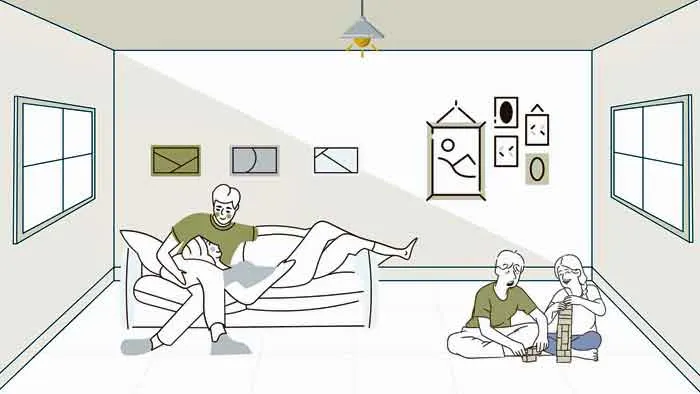
“We are little ovens.”
As unbelievable as it may seem, a 20 m² room in a passive house can be warmed up by the body heat of 4 occupants.
“Our house uses as much energy as a lightbulb.”
Passive houses are so energy efficient that they can maintain indoor comfort at a temperature of 21 °C with an energy consumption equivalent to that of a 65 watt light bulb. This means great energy independence for you and protects you against the erratic fluctuations in the electricity price.
“Barefoot all year round.”
Anyone who likes to walk barefoot will find their ideal home in a passive house. The excellent insulation keeps the entire structure at a comfortable temperature, including the floor. Choose the right type of floor, preferably warm materials like wood, and your family can walk around barefoot all year round. The floor also becomes an excellent playing area for children.
A passive house cools and consumes little energy
A passive house heats and cools “passively” and consumes almost no energy.
In winter, the house makes the most of weather conditions and efficiently benefits from the sun, internal heat sources and heat recovery from the ventilation system to warm up.
In summer, passive cooling techniques, such as the strategic use of shaded areas or pre-cooling of the supply air, are used to keep it comfortably cool, even when it is much warmer outside.
The 5 basic principles of a passive house
In our projects we follow the 5 basic principles of the German building code for a passive house.
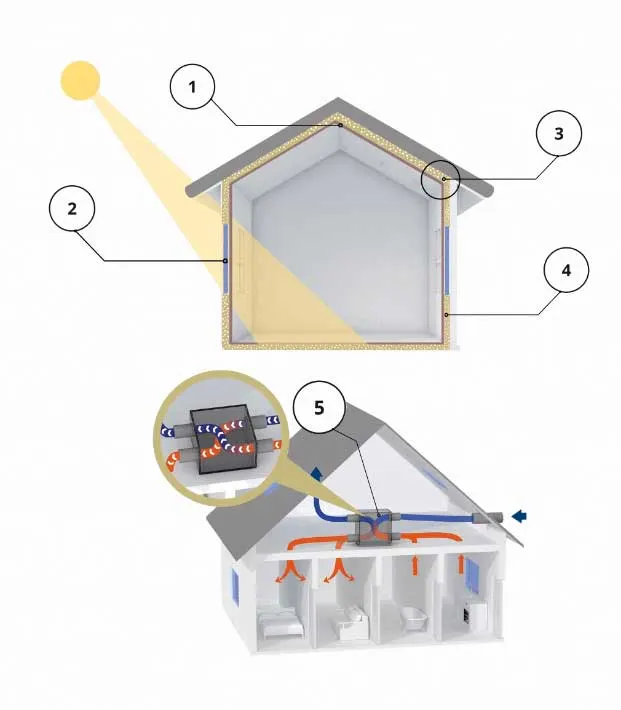
Airtightness of the building
The shell of a passive house must prevent the uncontrolled passage of air. For this reason, we pay great attention to its compactness during construction.
Read more
The building systems we use promote the formation of a continuous shell and minimize the conflict points where drafts or thermal bridges can occur.
This ensures that all sections are properly sealed, achieving optimal energy efficiency.
High quality windows and doors
The window frames are placed efficiently and strategically to get the most out of them. The windows and doors that we install in our projects are equipped with double or even triple glazing.
Read more
Their precise orientation allows the house to make better use of solar radiation (when the doors and windows are closed) and natural ventilation (when the windows are open).
In winter, solar radiation heats the house, while in summer passive cooling methods block this radiation to prevent overheating. All these measures provide a natural and comfortable indoor climate all year round.
Freedom from thermal bridges
A thermal bridge is a break or weakness in the insulating surface of the building envelope. It leads to heat being lost in winter or entering the house in summer, and can cause condensation, moisture or mold.
Read more
To avoid these problems, passive house constructions are carefully designed to ensure that all parts of the house are fully and durably sealed.
This avoids energy losses and the formation of condensation spots and achieves higher energy efficiency.
Thermal insulation
Energy loss through facades, window frames, floors and roofs is minimal. The thickness of the insulation is double or even triple that of conventional houses.
Read more
Thanks to the construction system used and especially the choice of insulation, thickness and continuity, we achieve exceptional energy efficiency and comfort.
By keeping the temperature close to 20 °C even on the wall surfaces, thermal comfort for the occupants is guaranteed. It is this continuous insulation, which runs through the entire thermal envelope of the building, that prevents cold bridges or air infiltration.
The high quality of the insulation contributes to the energy neutrality of the house, as the temperature can be better maintained and noise pollution from the outside is avoided.
Heat recovery through mechanical ventilation
The mechanical ventilation system is a crucial factor in maintaining the right temperature throughout the year. It avoids moisture problems and ensures the longevity of the building.
Read more
Ventilation avoids moisture problems, which is very beneficial for the health of the inhabitants of the house, and prevents condensation and mold.
The fact that you do not have to open the windows for ventilation is an advantage, especially in winter. In summer, you can ventilate at night to remove the heat accumulated during the day.
The operation is simple. The system uses filters that clean the incoming and outgoing air before it enters the house, and depending on the season it provides heat exchange between the incoming and outgoing air to heat or cool the house.
How to live in a passive house in Mallorca?
No drafts from windows or doors
No cold zones in all rooms
No sudden temperature differences
No noisy and expensive heating and air conditioning systems
South facing and protection from the sun
Each house is designed to make optimum use of the special climatic and geographical conditions of its location.
The orientation of a Passive House and the design of the facade openings are crucial for the (positive) energy balance. Therefore, when building a Passive House on Mallorca, we look for the best sky orientation on the property, the prevailing wind direction, etc.
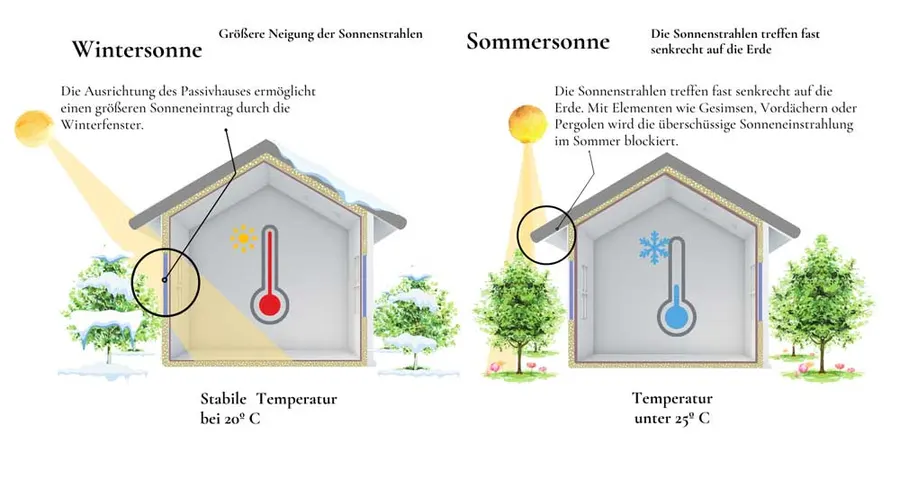
In a mild climate like Mallorca, the sun’s rays are more inclined in winter, while in summer they shine almost vertically. This means that the best orientation for a house in the northern hemisphere is south.
Therefore, we design the facades with large openings and glass surfaces facing south, which act as heat collectors and natural radiators in winter.
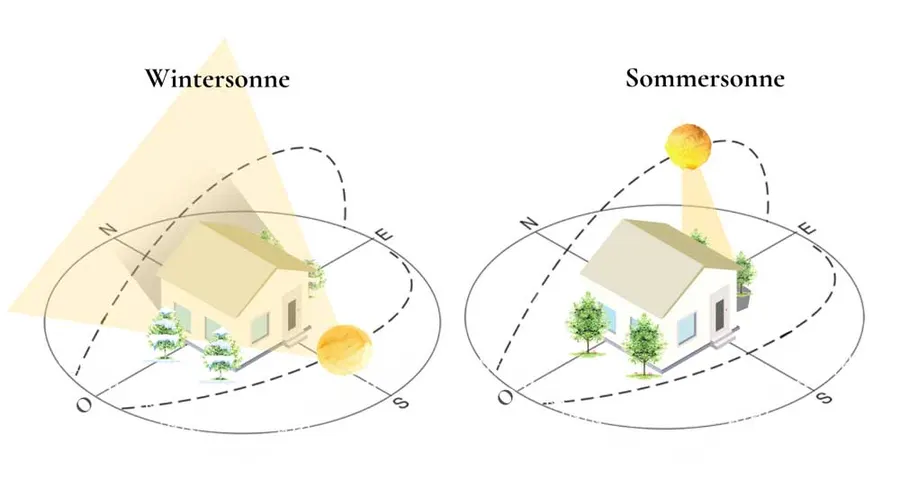
This orientation allows more sunlight to come through the windows in the winter, just when it is needed. In the summer, we avoid an excess of sunlight by creating shaded areas such as porches, eaves, awnings and pergolas, or even shade from natural elements such as trees or vines.
These shaded areas protect the house from the sun’s rays, keeping the house cool in the summer.
Frequently asked questions
Are all passive houses in Mallorca the same?
The answer is no. It is important to distinguish between passive houses and passive houses that are certified.
Full answer
The Passive House Standard is the world’s most stringent and fastest growing energy efficiency certification. The secret of its success is quite simple: it keeps what it promises. Houses that want to bear this official seal of quality must meet the demanding criteria of the Passive House Institute.
The official certification guarantees that the house really meets the requirements for high energy efficiency. This means that certified houses have a higher market value.
Casal Mallorquí specializes in the construction of passive houses, certified by the Passive House Institute, so we can build your house with official certification if you wish.
Do Passive Houses heat up by themselves?
No, passive houses do not heat themselves. They are designed and built so that the insulation retains heat and does not lose it.
Full answer
This makes it possible to heat the houses with a minimal heat source. The same goes for cooling.
Passive Houses are heated or cooled with minimum energy costs, while retaining the greatest possible amount of heat or cold to achieve maximum comfort.
Are you not allowed to open the windows?
Of course you can open the windows. In practice this is usually not done, because it is not necessary.
Full answer
The mechanical ventilation system with heat recovery completely renews and cleans the air in the house in two to three hours.
The air that the occupants of the house finally breathe in is therefore of a higher quality than the outside air.
Is it more expensive to build a passive house on Mallorca?
The additional costs are between 5 and 10%, and it is common to recoup them before 10 years have elapsed.
Full answer
A passive house saves 90% of heating and cooling costs. Over time, these savings outweigh the small additional construction costs.
The cost of building a house depends on many factors (area, construction, qualities, number of rooms, etc.).
We must make the distinction between price and value here. Even if the construction price of a passive house may be a bit higher, living in a house with unparalleled comfort is priceless in terms of quality of life.
If the house retains the heat, is this standard suitable for Mallorca?
The passive house standard has proven to be very efficient in both cold and hot climates.
Full answer
Passive houses are equipped with a double ventilation system that makes it possible to cool the air in the room in a very simple way.
The fresh air brought in from outside at night flows directly into the house without being heated by the warm air from the house. The result is an ideal temperature even during the hottest summer days in Mallorca.
What materials are passive houses made of?
Traditional materials (cement, concrete and steel), materials of natural origin such as wood, or a combination of both.
Full answer
At Casal Mallorquí, we can respond to the individual requirements of builders who want to build their passive house with traditional materials or prefer a construction with an outer shell made of wood.
In both cases, the end result will be a comfortable house with perfect insulation. The choice of material does not determine the style of the passive house or its energy efficiency, and a house with a timber shell and structure looks no different from one built with conventional materials.
Not all options are equally environmentally friendly. Wood is undoubtedly the best option: it is a 100% recyclable and sustainable material, so its use reduces our carbon footprint.
How is the temperature maintained in passive houses?
The most important heat sources are natural: the sun, household appliances, artificial light and body heat.
Full answer
Factors such as the material and thickness of the walls or the insulation of the windows, floor and roof help maintain a constant temperature by preventing heat from being transferred from inside to outside in winter, or vice versa in summer.
Do passive houses need air conditioning?
This is usually not necessary. Passive Houses dissipate the heat through mechanisms that help to cool and prevent overheating.
Full answer
Some of these are the south orientation of the house, the use of vegetation and planning for external shading and sun protection such as pergolas and canopies.
In addition, the insulation and placement of windows and doors should be planned in detail to minimize the use of air conditioning. Instead, cross-ventilation can be used at night during the summer months to maintain the optimal temperature during the day.
Why is now the ideal time for a passive house on Mallorca?
From December 31, 2020, all newly built houses must be low-energy houses.
Full answer
And soon the laws to protect the environment will become stricter and even apply to already built houses. In Germany, Belgium and Austria there are even regions where it is mandatory to build public buildings according to this standard.
If you take the first step now and build the house of the future, you will save yourself the inconvenience of having to adapt your house to the new legislation in a few years’ time. It’s a chance to save yourself a lot of time, money and hassle.
Curious about how we build a passive house on Mallorca?
The best way to understand why a Passive House is built faster than a traditional house is by watching the video of our project being built in Cala Murada.
- Planning of the passive house
- Building according to the specifications
- Construction monitoring
- Turnkey passive house
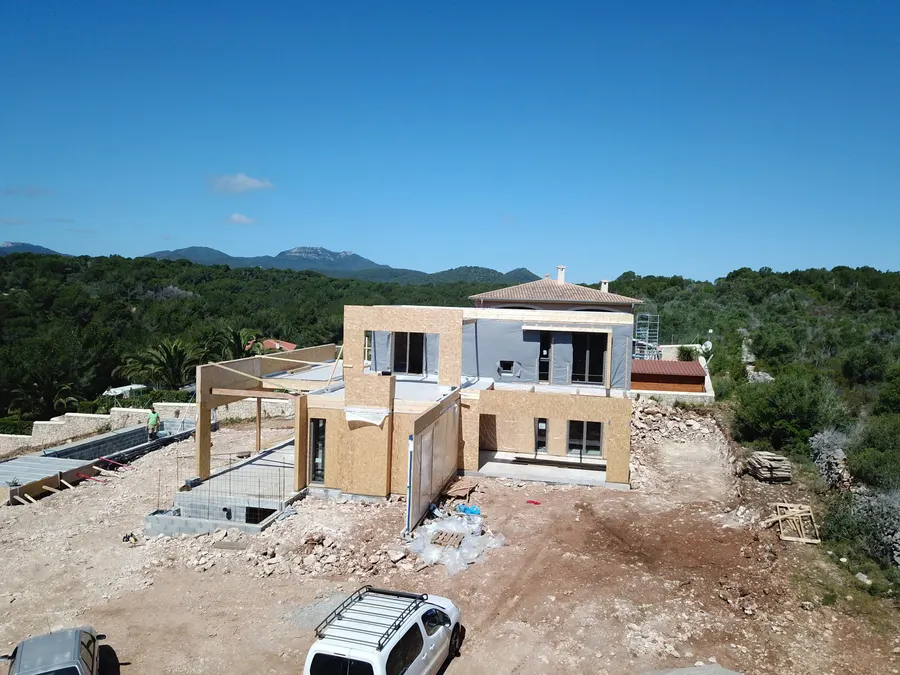 Video on YouTubeBuilding a modern Passive House in Cala Murada, Mallorca
Contact us here
info@casalmallorqui.com · +34 667 626 823 · Carrer Lleó XIII 11, 07500 Manacor, Mallorca